Volunteer Experience
How to Thank PTO Volunteers So They Come Back
How to thank PTO volunteers so they come back: five copy-and-paste notes for private thanks, kind public shout-outs, from-home helpers, and no-ask thank-yous.

Copy this, fill in the brackets, and send it today to one person who helped this fall:
Hi [first name], I keep thinking about [the specific thing: the two hours you spent sorting book-fair returns / the Spanish version of the conference flyer you finished on a Sunday night]. Because of you, [the result: every class had its books back by Friday / families who read Spanish first knew the conference schedule on time]. Thank you. It made a real difference for our kids, and for me. [Your name]
No sign-up link, no "P.S. we still need…" If you're wondering how to thank PTO volunteers so they actually come back, start with a note like that one: specific, quick, and with nothing attached.
Why does a specific thank-you keep volunteers coming back?
People step back quietly when their work feels invisible. In an r/education discussion about parent-group participation, one school volunteer argued that what gets called burnout is often something else: active volunteers drift away when they feel unwelcome, unheard, or unappreciated.
Research backs that up. In experiments by Adam Grant and Francesca Gino, summarized by Stanford Graduate School of Business, a short thank-you more than doubled the share of helpers who agreed to help again (from 25% to 55% in one study), because they felt socially valued. National PTA's guidance on developing volunteers puts it simply: recognize volunteers and thank them regularly, and remember that your board members are volunteers too.
Timing matters. SignUpGenius recommends a thank-you within 48 hours that names what the person did and why it mattered. Thanks saved for a May banquet arrive after many people have already decided whether to return.
How to thank PTO volunteers: five templates to copy
1. The private note: one task, one result
Use the note at the top. If it could go to anyone, it isn't specific enough. Name the task, the day, and one thing that changed for students or teachers. A text, an email, or a card in a child's folder all count.
2. The public shout-out that leaves no one out
Thank you to everyone who made [event] happen: the setup crew, the bakers, the people who [ran the cash box / kept the line moving], and the families who helped from home. Because of you, [result]. If you helped and we missed your name, please tell us. We want to get it right.
Thank people by job, not by rank. Skip "top volunteer" call-outs, and ask before posting anyone's photo or full name. In one r/kindergarten thread, a parent who had helped plan asked if she was too sensitive for minding being left out of the PTA's public thanks. That last line is your safety net.
3. The note for the from-home helper
Hi [name], I know you weren't in the gym on [event night], but [the labels you printed / the sign-up you built / the receipts you sorted at your kitchen table] are a big reason it ran smoothly. Thank you for the work nobody saw.
Flyers, sign-ups, translations, and receipts never make it into the event photo. Say out loud that the work counted.
4. The thank-you with no ask attached
I just wanted to say thank you for [task]. That's the whole message. No sign-up link, I promise. Enjoy the break.
When you need help again, ask separately, on another day. A thank-you with a request attached reads like a transaction.
5. The running "who helped" list
Keep one short list per event: name, what they did, how you know (sign-up, a text, a teacher's mention), and the date you thanked them. Add names as you go, not from memory in December.
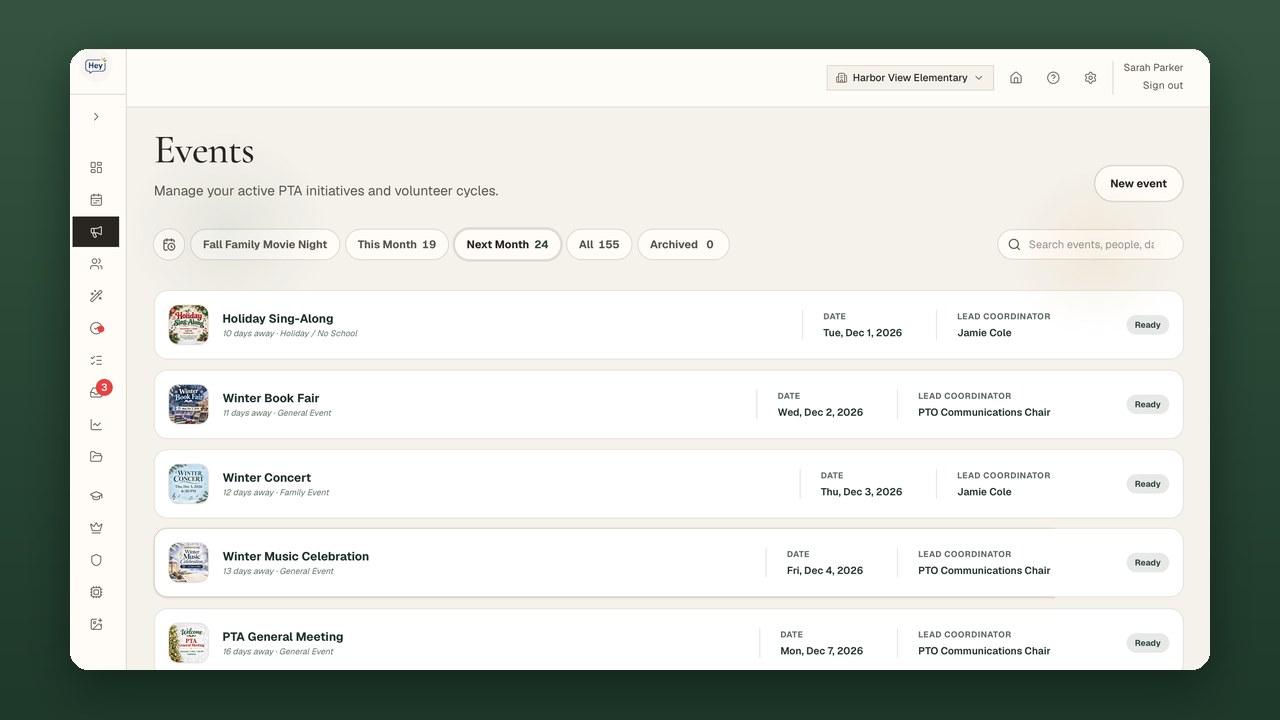
If your events are in Hey Ralli, the event's Volunteers tab can be your starting point. When a SignUpGenius sign-up is connected and its participant list is public, the names of people who signed up appear with the event. Copy them onto your list, then add the people who never signed up, like the parent who brought muffins or the dad who stayed to stack chairs.
When should you send the thank-yous this month?
Send them this week or early next, before Thanksgiving break (Thanksgiving is Thursday, November 26). Then stop: no new asks over break and no "quick question" texts to the board. Let volunteers, and your board, actually rest. Giving Tuesday on December 1 and your mid-year update for members will still be there when everyone gets back. If the same few people carried the fall, read our guide to sharing the PTO load before the holidays next.
Quick FAQ
Can we use PTO money for volunteer gifts? Check your state PTA's rules first. California State PTA says PTA funds can't buy personal gifts for individuals; members can donate those items instead. A specific note costs nothing.
What if we left someone out? Send that person a private note right away and own it: "We missed your name, and we shouldn't have. Thank you for [task]."
Do we still need an end-of-year celebration? It's a nice tradition, and California State PTA suggests budgeting for one near the end of the year. Notes now help keep people around until then.
Sources
- National PTA, "Developing Volunteers," Local Leader Kit (recognize and thank volunteers regularly; board members are volunteers too)
- California State PTA, "Volunteer Appreciation," Toolkit (end-of-year appreciation event; personal gifts can't be bought with PTA funds)
- SignUpGenius, "How to Get More Volunteers to Sign Up and Show Up" (thank-you within 48 hours that names what the person did and why it mattered)
- Stanford Graduate School of Business, Francis J. Flynn, "Gratitude, the Gift that Keeps on Giving" (summary of Grant and Gino, Journal of Personality and Social Psychology, 2010)
- r/education, "Your thoughts on participation trends among parent-teacher organizations" and r/kindergarten, "PTA: Am I being overly sensitive?" (real parent concerns, paraphrased; not sources of statistics)